Logged in as: Anonymous User sign in
Research_banner
Csl_research
 
Printer Friendly Format


Geophysics & Petrophysics

Petrophysics is the study if the physical properties of the rocks. The main goal of our petrophysical studies is assessment of the controlling parameters, such as porosity, pore structures, pressure, saturation and mineralogy on sonic velocity and permeability in carbonates. Understanding the relative importance of all these parameters is important to assess the uncertainties that arise when using theoretical equations to interpret or predict velocity, porosity and permeability trends from subsurface data sets. 
Our current focus is to test several assumptions in rock physics. For example, experiments have revealed that the basic assumption in Gassmann’s equation, which says that the dry and wet shear moduli are constant, needs to be questioned in carbonates. A series of projects address the causes for this shear modulus variability and the effect of saturation on sonic velocity in carbonates. The results of these experiments will provide a guidance of assessing uncertainties in AVO analysis and time-lapse seismic surveys. 
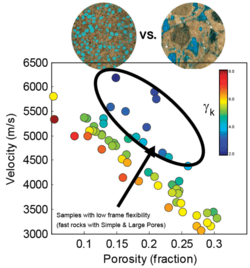
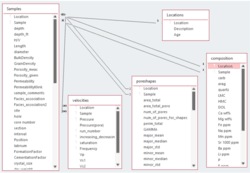
In earlier studies we documented the importance of pore structures on velocity at a given porosity, and qualitatively related pore types to these velocity variations. Digital image analysis of pore structures yield a quantitative way to estimate their influence on sonic velocity and permeability. In addition, high-resolution CT–scans of plug samples increases our pore structure analysis from 2-D to 3-D. Over the last years we started to assemble a data-base on dolomites and plan to focus on the sonic velocity and permeability in dolomites to get a better understanding of the petrophysical behavior of various types of dolomite. 
Core material from several drill sites are used for integrated studies of the sedimentologic, diagenetic, petrophysical characteristics of oolithic grainstone bodies which determine the influence of early cementation on sonic and hydraulic properties, and the cause for the heterogeneity in such oolithic grainstone settings.

Current Projects


Seismic and GPR Diffractions: Towards the next generation of Small Scale Discontinuity Imaging

Grasmueck

Project Media
     
Grasmueck...ctus.pdf
Media Type:Article
File Size:892KB


Investigators: Mark Grasmueck, Tijmen Jan Moser, and Michael A. Pelissier

Objectives:

  • Determine the basic geological features capable of generating measurable diffractions in the near surface and at reservoir depth.
  • High-resolution 3D Ground Penetrating Radar (GPR) cubes and outcrop observations serve as a bridge between synthetic models and real seismic data.
  • Assemble a catalog of typical diffraction signatures to identify and quantify subwavelength discontinuities in complex geology such as fracture corridors and salt flanks.


4D GPR for Quantification and Characterization of Fluid Flow in Fractured Carbonates

Marchesini

Project Media
     
Marchesin...ctus.pdf
Media Type:Article
File Size:168KB


Investigators: Pierpaolo Marchesini, Mark Grasmueck, and Gregor P. Eberli

Objectives:

  • Calculate volumetric water content changes and visualize wetting/draining zones as the response to a controlled infiltration experiment in fractured carbonates.
  • Compute flow rates within porous matrix and quantify influence of faults and deformation bands on flow.
  • Relate flow parameters to geology: faults, deformation bands, stratigraphy, petrophysics of rock matrix.
  • Compare results with Miami Oolite infiltration experiment.


Rock Fluid Interaction: Velocity Evolution during Controlled Precipitation and/or Dissolution

Weger_2012

Project Media
     
Weger_201...AAPG.pdfsponsors only content
Media Type:Presentation
File Size:8MB
Weger_eta...ctus.pdf
Media Type:Poster
File Size:462KB


Investigators: Ralf J. Weger, Peter K. Swart, and Gregor P. Eberli

The processes of rock/fluid interaction and diagenetic alteration of carbonate rocks are well understood, but little data exist to quantify the resulting changes and their influence on petrophysical properties. In this project, experiments will be performed in order to:

  • Quantify the chemical changes in the fluids and the diagenetic and petrophysicaln changes in the rocks
  • Enhance our understanding of the effects of chemical rock-fluid interaction
  • Capture changes of acoustic velocity and permeability during chemically controlled rock-fluid interaction


Sub-Micron Digital Image Analysis (ESEM-DIA), Pore Geometries and Electrical Resisivity in Carbonate Rocks

Norbisrath

Project Media
     
Norbisrat...AAPG.pdfsponsors only content
Media Type:Poster
File Size:4MB
Norbisrat...ctus.pdf
Media Type:Article
File Size:316KB


Investigators: Jan H. Norbisrath, Gregor P. Eberli, and Ralf J. Weger

Objectives:

  • Assess the controls of the sub-micron pore structure on electrical resistivity.
  • Expand the resistivity dataset to dolomites and combine with existing datasets.
  • Develop methods to apply Digital Image Analysis (DIA) to Environmental Scanning Electron Microscopy (ESEM) imagery; combine and compare with Mercury Injection Capillary Pressure (MICP) and/or μ-CT measurements.


Reservoir Potential of Cretaceous-Paleocene Carbonate Turbidite Successions: A Core and Outcrop Study, Adriatic Sea, Italy

Maura

Project Media
     
Maura_201...AAPG.pdfsponsors only content
Media Type:Presentation
File Size:10MB
Maura_eta...ctus.pdf
Media Type:Article
File Size:394KB


Investigators: Irena Andisa Maura, Gregor P. Eberli, and Daniel Bernoulli

The main goal is of this project is to assess the reservoir potential of Cretaceous– Tertiary carbonate turbidite successions through a sedimentological, diagenetic, and petrophysical characterization of the strata in the basin adjacent to Adriatic carbonate platforms. The main tasks for this year are:

  • Petrophysical characterization of the re-deposited carbonates that includes permeability, porosity, sonic velocity, and resistivity measurements from the core plugs.
  • Comparative study of coeval onshore strata at Monte Conero and the Maiella Mountains, and coeval strata in the Bahamas.


Petrophysical Properties and Pore Structures in Microbialites

Eberli_Micr

Project Media
     
Eberli_et...ctus.pdf
Media Type:Article
File Size:146KB


Investigators: Gregor P. Eberli, Giovanna della Porta, Ralf J. Weger, and Jan H. Norbisrath

Objectives:

  • Assemble a comprehensive petrophysical database of microbialites, including stromatolites, travertine, and tufa.
  • Quantify pore structures of microbialites.
  • Correlate pore structures to petrophysical properties and classes of microbialites.


Petrophysical Properties of Unconventional Reservoirs: Start of a Database

Weger_UCR

Project Media
     
Weger_eta...ctus.pdf
Media Type:Article
File Size:139KB


Investigators: Ralf J. Weger, Jan h. Norbisrath, and Gregor P. Eberli

Objectives:

  • Assemble a database that covers many of the varieties of shales found in unconventional reservoirs.
  • Correlate petrophysical properties to carbonate content and TOC to better understand the enhanced fracability of carbonate-bearing shales.


||©Comparative Sedimentology Laboratory 2004||